
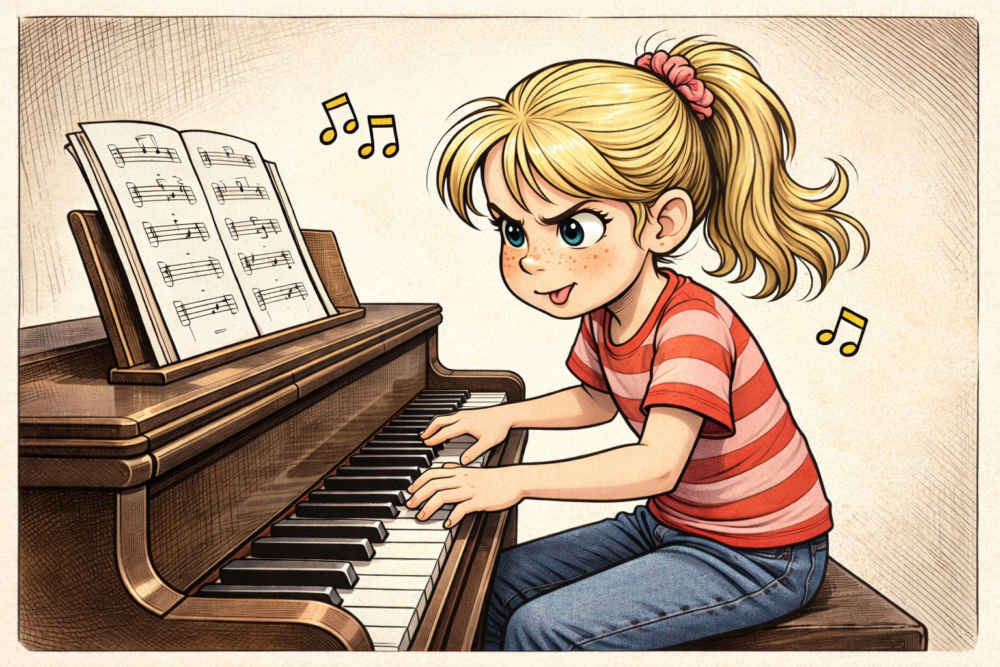
When I was around six years old, my parents signed my sister and me up for piano lessons. I can confidently say that I was not enrolled in music lessons because I had been asking my parents for them or because they saw some budding musical talent in me that was just waiting to be sharpened. The videos from my earliest days as a musician refute the possibility of a musical prodigy. Neither my sister nor I was overly passionate about piano at first; our teacher, though too nice to ever say it, probably wished we practiced a lot more and yawned a lot less. Despite how grudgingly we sometimes approached the piano, it was an early Sunday-morning routine that was a constant in our young lives and remained relevant in our adult ones.
Never having practiced much, we made slow progress, but my relationship with the piano would soon change. When I was about thirteen, I had a crush on a boy in my homeroom class. He was obsessed with video games, so I decided one day that I would learn a song from a game to serenade him and ultimately win his love. Unfortunately, at the time, I was not at a high enough level to play the song, so with a rejuvenated drive to practice and learn, I asked my parents to increase my lessons from once to three to four times a week, to pick up the slack. This upsurge in lessons drastically improved my piano prowess. I quickly found myself interested in piano in a way I had never been before, encouraged by my visible progress. It became meaningful to me, an impressive skill that I could show off as well as improve with time, and something that would stick around for the duration of my life.
Despite this, my piano journey did not remain on an exponential trajectory. I attended boarding high school, and my proximity to a piano went from a few rooms to a few buildings away. I found myself busier than ever and lost the motivation to make the long trek to the practice rooms and play. I practiced less and less frequently during the school year, growing far rustier, until my repertoire slipped to two songs I could play from memory. I was not learning any new pieces, exclusively whipping these two out to show off once in a while.
My relationship with the piano has ebbed and flowed, however. My neglected piano skills did not prove to be a permanent failure or the end of the story, and my periods of resistance or apathy were not signs to quit, but rather, a normal part of learning any lifelong skill. In college, while still inconveniently far from the practice rooms, I found myself missing the piano and decided to pursue a minor in music. While not a top priority, I knew I would return to practicing, and sure enough, I enrolled in private music lessons this semester, looking to make the piano a central part of my life once more. Playing with new friends, learning and teaching new songs, reminded me of the joy the piano brings to my life, and I am excited to make time for it once more.
Despite inconsistent practice over the span of thirteen years, my love of piano and music has remained constant, and I find myself returning to it again and again, knowing that it will be a skill I cherish for the rest of my life. Even my sister, who stopped lessons years ago, still finds herself sitting down at the piano at home, reminiscing via old pieces. My parents, who were also made to play as children, often say they wish they had stuck with it long enough to carry the skill into adulthood. If my journey and my family’s regrets reveal anything, it is that one is far more likely to regret stopping piano than taking ‘too many lessons’ or playing ‘too much.’ Although I have not practiced the piano consistently since I started lessons, I always faithfully return to it, glad to have a sturdy foundation to fall back on. While practice habits can be reestablished, I’m forever grateful I ultimately stuck with it, as quitting is much harder to undo. So, is persistence more important than practice? I would say so.

Leave a Comment